


The news that a super large lithium mine has been discovered in Linwu County of Chenzhou City drew much attention from all parties when it was made public in July last year.
The lithium battery industry in Chenzhou is rising in Hunan province.
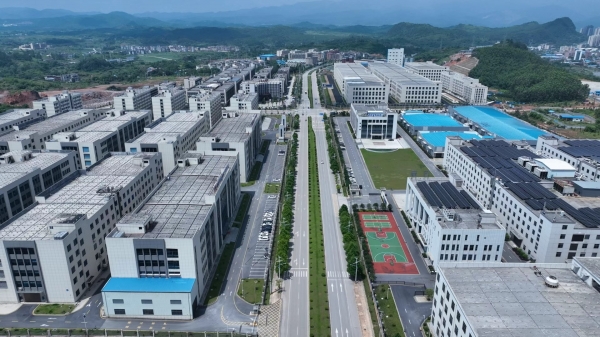
To turn resources into an industrial advantage, in recent years, Chenzhou, taking the opportunity for the development of lithium battery new energy industry, and with the goal of building a battery city, has issued robust policies, provided proactive services, and explored a path for the chain development of lithium battery new energy industry with high-level planning, new mechanisms, and practical guarantees.
Chenzhou has formulated the “Chenzhou Battery Industry Development Plan (2022-2032)”, which clarifies the “1546” development strategy, that is, to set the overall goal of building a “Battery City”, clearly define the five paths of resource-, lithium battery, recycling, openness, and service, focus on four key areas of lithium-ion batteries, solar cells, hydrogen fuel cells, and lead-acid batteries, and promote six key projects--building the industrial foundation with mineral resources, strengthening industrial entities, technological innovation empowerment, industrial ecology driving, advanced manufacturing demonstration, and quality brands leading the way.
Chenzhou has adhered to the working principles including “upstream introducing downstream, downstream matching upstream”, “resources for industry, and leading enterprises as leaders”, to ensure that the mining, beneficiation, and smelting of lithium containing mineral resources are concentrated in one operating entity, so as to grasp the keys in the development of the entire industry chain, with the enterprise that acquires the resources as the chain owner, responsible for building production bases of positive electrode materials and battery cells.
Chenzhou, which adheres to the principle of “ecological priority and green development”, has promoted green and intelligent development, demanding the reduction, harmless and resourceful treatment of tailings and valuable elements generated from the mining and utilization of lithium mineral resources, with the utilization rate of tailings of over 80%, and the recovery rate of associated valuable elements of over 60%.
Chenzhou has made efforts to seek support from superior authorities. The provincial government has formulated and implemented the “Several Measures to Support the High-Quality Development of the Lithium Battery New Energy Industry Chain in Chenzhou City”.
A high-level leadership group for the development of the city's battery industry has been established at the municipal level, with the Secretary of the Municipal Party Committee serving as an advisor and the Mayor as the group leader. A lithium battery work team has also been formed, with two city leaders serving as chain leaders. Each key county, city, and district will select backbone forces to form specialized working teams.
Chenzhou combines the resource endowment and industrial foundation of each county, city, and district (park) to establish a linkage mechanism to ensure a reasonable industrial layout.
It plans lithium carbonate production enterprises in resource producing areas, lithium battery manufacturing and new energy terminal equipment in central urban areas, and comprehensive recycling and utilization enterprises for waste lithium batteries in chemical industrial parks.
Each county, city, and district supports one another and develops in different ways, focusing on targeted investment promotion.
In recent years, the city has signed a total of 221 projects in the lithium-ion new energy industry.
Chenzhou, using resources as a lever, has guided upstream and downstream enterprises in the entire industry chain to establish a mechanism for sharing benefits, risks, and collaborative promotion through mutual shareholding, signing long-term contracts, technical cooperation, and price concessions.
The city has attracted seven major projects, including Shanghai Ane, CORUN, Dazhong Mining Shenzhen Dawei Technology in a consortium development model, with a total contracted amount exceeding 140 billion yuan.
Two listed companies, CORUN and Willing Shares, have relocated their headquarters to Chenzhou.
Chenzhou successfully held the first Round-table Conference on Innovative Application of Lithium Resources in Hunan. 560 academicians and experts, heads of well-known domestic lithium battery enterprises were invited to attend the conference; 9 colleges and universities, including the Institute of Physics of the Chinese Academy of Sciences, the National Engineering Center for Advanced Energy Storage Materials, and Harbin Institute of Technology, signed technical cooperation agreements with enterprises on the spot.
It has successively built pilot production lines for solid-state batteries, lithium manganese iron phosphate, and comprehensive recovery of beryllium metal, effectively solving a number of long-term problems.
It has established research platforms such as Chenjiang Laboratory, Central South University Science and Technology Achievement Transformation Base, and Nonferrous Metals and Energy Storage New Materials Research Institute, and built a pilot base to strengthen the new driving force of lithium battery innovation and development.
Chenzhou has actively carried out targeted measures to promote project construction, and designated dedicated personnel to provide full cycle services for key lithium battery new energy projects.
It has introduced the “Several Measures for Optimizing the Business Environment with Cost Reduction as the Core in Chenzhou City”, supporting the development of the lithium-ion new energy industry with 39 hard core measures.
Chenzhou has opened a “green approval” channel through methods such as “vacating the cage to change birds”, and “land supermarket”, to guarantee key factors such as land, energy, and personnel.
All seven consortium projects have entered the first phase of construction.
At present, 75 lithium battery new energy industry projects have been completed and put into operation in the city, with a completed investment of 42.5 billion yuan, involving the annual production capacity of 60,000 tons of lithium carbonate, 10,000 tons of lithium fluoride, 3,000 tons of lithium hexafluorophosphate, 17.5 GWh of battery cells, and 220,000 tons of comprehensive recycling of waste batteries.
The city's lithium battery new energy industry cluster is accelerating toward the goal of 100 billion yuan in the total output value.
Chinese source: hunantoday


 湘ICP备13003667号
