


A train from Nansha Port of Guangzhou loaded with 22 TEUs of 600 tons of silver concentrates from Peru arrived at Chenzhou Land Port of Chenzhou City recently, which will be then sent to Hunan Silver Co., Ltd..
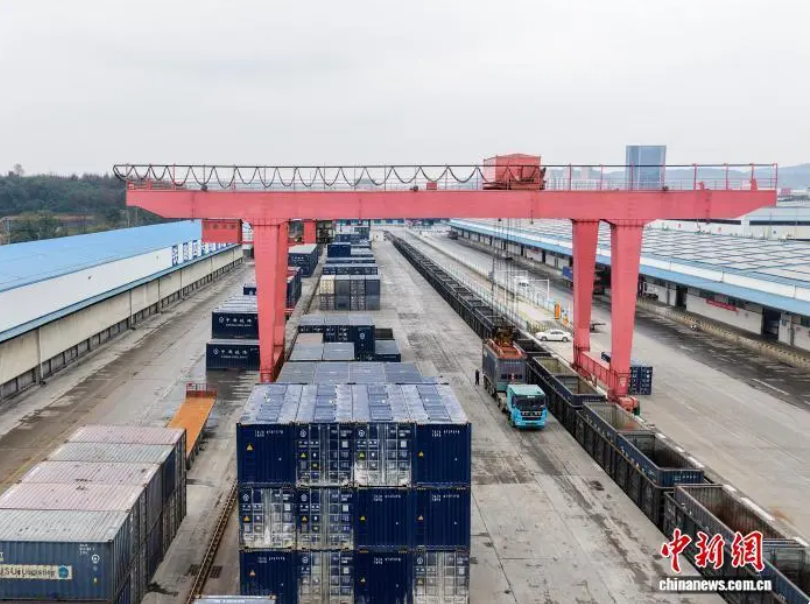
“In the past, the imported mineral products from a sea port were transported to Chenzhou mainly by road, requiring a large number of trucks. Enterprises had to coordinate with multiple logistics companies, which was rather time-consuming and laborious.” Wu Jianhua, the business manager of a logistics company in Chenzhou responsible for the customs clearance of this batch of ore imports, said that automobile transportation was neither theft-proof or waterproof, and the damage caused by severe weather could also pose safety hazards to smelting.
Nowadays, goods are transported directly from sea ports to land ports, and railway containers are fully enclosed throughout the journey, featuring high transportation capacity, low losses, and greater environmental friendliness.
Wu Jianhua's speech reflects the efficiency improvement of the leading advantageous industries in Chenzhou, known as the “hometown of non-ferrous metals in China”, under the logistics reform.
The import of bulk mineral products is an important sector of Chenzhou's foreign trade, and the efficiency and cost of its logistics are directly related to industrial competitiveness.To this end, in 2025, Chenzhou Land Port reached out for Guangzhou Port and China Railway Guangzhou Group to innovate a “quantity-based price guarantee” negotiation mechanism, and secured a 51% reduction in railway freight rates for mineral products, saving about 400 yuan in freight costs per standard container.
As of now, this mechanism has reduced costs by about 1.2 million yuan for more than ten non-ferrous metal enterprises, driving an increase of 88,000 tons of imported mineral products.
The combination of innovative models and preferential policies not only brings real benefits to enterprises, but also optimizes the regional business environment and enhances industrial competitiveness.
At the same time, Chenzhou Land Port has pioneered the full process bill of lading business for rail-sea intermodal imports in Hunan Province, with 8 rail-sea intermodal full process bill of lading routes in Nigeria, Kenya, Tanzania, Myanmar, Cambodia, India, etc., continuously expanding the international “friend circle”, and enabling the land port to have functions of an “international port”, with the dominance and convenience of international logistics greatly improved.
Xie Zhiyu, general manager of Xiangyuefei International Logistics Co., Ltd., said that Chenzhou Land Port is not only a fast track for importing raw materials, but also a core hub for inland goods to go global.
A special train loaded with high-quality kitchenware made by Zhengrun Foundry Company in Jiahe County reached Yantian Port in Shenzhen through Hunan-Guangdong-Africa rail-sea intermodal channel, which were then sold to overseas markets in 27 EU countries on November 9, 2025.
20 containers of photovoltaic glass were directly shipped to India’s Tuticorin Port via Hunan-Guangdong-Africa rail-sea intermodal channel after going through customs clearance processes like declaration, inspection and release at the Customs Surveillance Zone of Chenzhou Land Port on December 25.
“We adopt the cross-customs supervision mode involving “Direct Loading Upon Arrival” and NVOCC (non-vessel operating common carrier) for cargo declaration and release, which eliminates the customs declaration process at coastal ports. After arrival, they are directly loaded onto ships for shipment, greatly reducing the time for goods to be stored and inspected at the port terminal.” Xie Zhiyu said that this effectively solves the problems of cumbersome cross customs procedures, redundant logistics links, and high comprehensive costs in the past.
At the same time, NVOCCs with international qualifications and deep involvement in international routes undertake export commissions from enterprises, integrate cabin information from multiple shipping companies, break the constraints of a single shipping company, and strive for more favorable freight rates for inland foreign trade enterprises, improving the efficiency of the entire transportation chain.
Chinese source: hunantoday


 湘ICP备13003667号
